🔥FIRE3D: Feed-forward Interactive 3D Scene Reconstruction Within A Minute
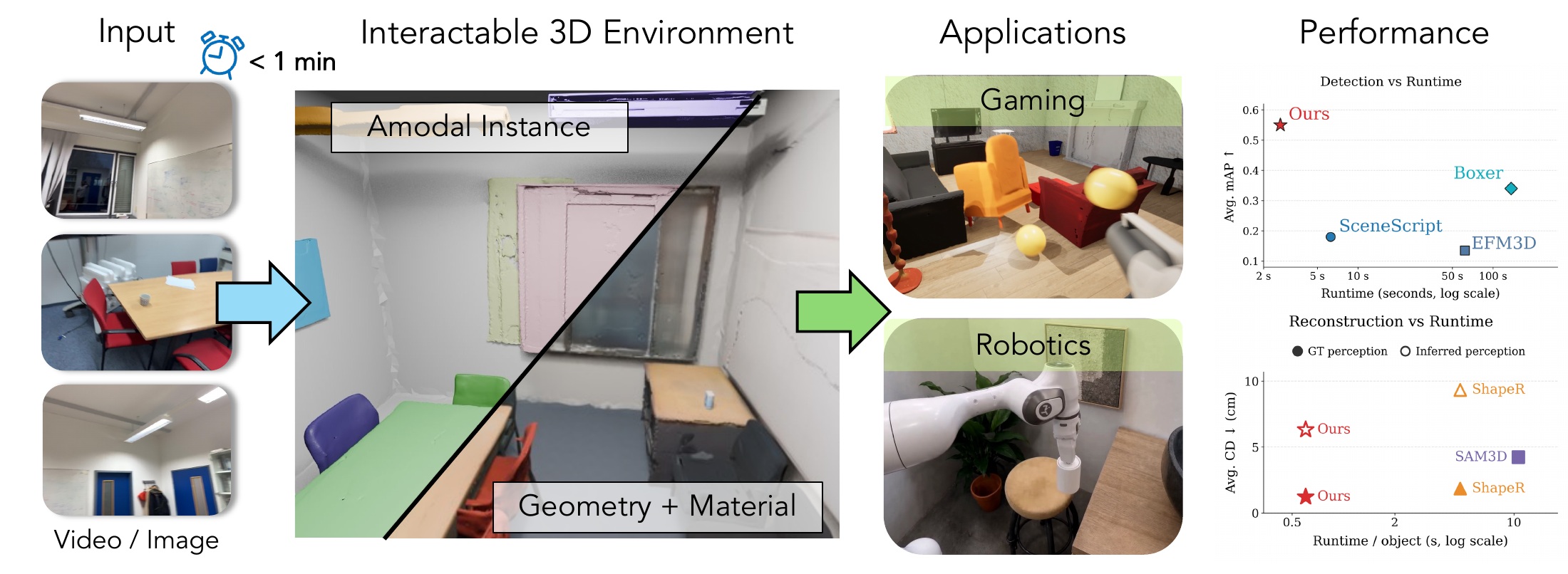
From an unsegmented image or casual video, one feed-forward system
discovers the objects and estimates their 6-DoF poses, then reconstructs
complete textured assets in under a minute.
31-second overviewFrom unsegmented observations to independently editable 3D scene assets.No supplied object masks, boxes, poses, or prompts. Fire3D predicts the scene decomposition and
reconstructs complete, textured, independently editable assets, including the room background.
The paper
Abstract
We present FIRE3D, a unified framework that transforms a single RGB image or casual video into interactable 3D scene assets for games and interactive applications in under a minute for up to twelve textured instances including preprocessing. At the core of FIRE3D is a feed-forward inference pipeline that predicts a compositional scene representation from posed RGB-D observations estimated from the RGB capture, including the 6-DoF pose, bounding box, mesh, and texture for detected objects. By modeling the scene as a collection of discrete entities, FIRE3D produces amodal object assets that can be independently edited and used in interactive applications. Our framework requires no test-time optimization, runs substantially faster than the compared reconstruction systems, and provides object-level completeness beyond existing feed-forward 3D approaches. We demonstrate leading detection accuracy, strong geometry reconstruction, and competitive rendering quality on the evaluated benchmarks, with substantial runtime gains.
The missing capability
What other pipelines ask you to provide, Fire3D learns to predict.
Strong 3D methods usually solve one part of the scene problem. Perception systems stop at boxes and
masks. Object generators start after an object has been selected. Optimization-based systems recover
a scene, but pay a new optimization cost for every capture. Fire3D closes these stages in one learned,
feed-forward system.
01 / Joint perception
No supplied object poses or segmentations.
The user supplies an RGB image or casual video. Pi3X, the Pi3 variant used in Fire3D, estimates point maps and camera poses; Fire3D
predicts the object count, 3D masks, oriented boxes, and 6-DoF poses without supplied masks, boxes,
object poses, or prompts.
02 / Complete output
Complete, independently editable scene assets.
Every predicted entity becomes an amodally complete mesh with PBR appearance in the metric scene.
Foreground objects remain independently transformable, while structural surfaces are reconstructed
as a background instance.
03 / Scene-scale generation
A scene is processed as a batch of objects.
HC-VAE reduces nominal latent feature capacity by 32×, allowing flow sampling, VAE decoding,
and mesh conversion to run across as many as 16 objects in parallel on one GPU, without test-time
optimization. Generation uses a fixed 12-step flow-sampling schedule.
Positioning
One system spans perception, completion, appearance, and scene assembly.
Representative methods are grouped by the part of the problem they are designed to solve.
Method familyPrimary strengthMissing or external stageScene-level outcome
Scene perceptionSceneScript · EFM3D · BoxerBoxes, masks, layoutsComplete geometry and materialScene understanding, not editable assets
Selected-object generationSAM 3D Objects · ShapeR · TRELLIS.2Amodal object reconstructionObject selection, masks, detection, or per-object preprocessingStrong objects; scene decomposition remains external
Per-scene optimizationHoloScene · SimReconObject-compositional scenesSearch, fitting, or iterative refinement for each captureEditable scenes at minutes-to-hours cost
Fire3DSingle image or casual videoJoint instance perception and reconstructionNo object-level perception input; no per-scene optimizationUp to twelve textured instances, including background, in under 60 seconds
Method
A single learned path from observations to interactable 3D scenes.
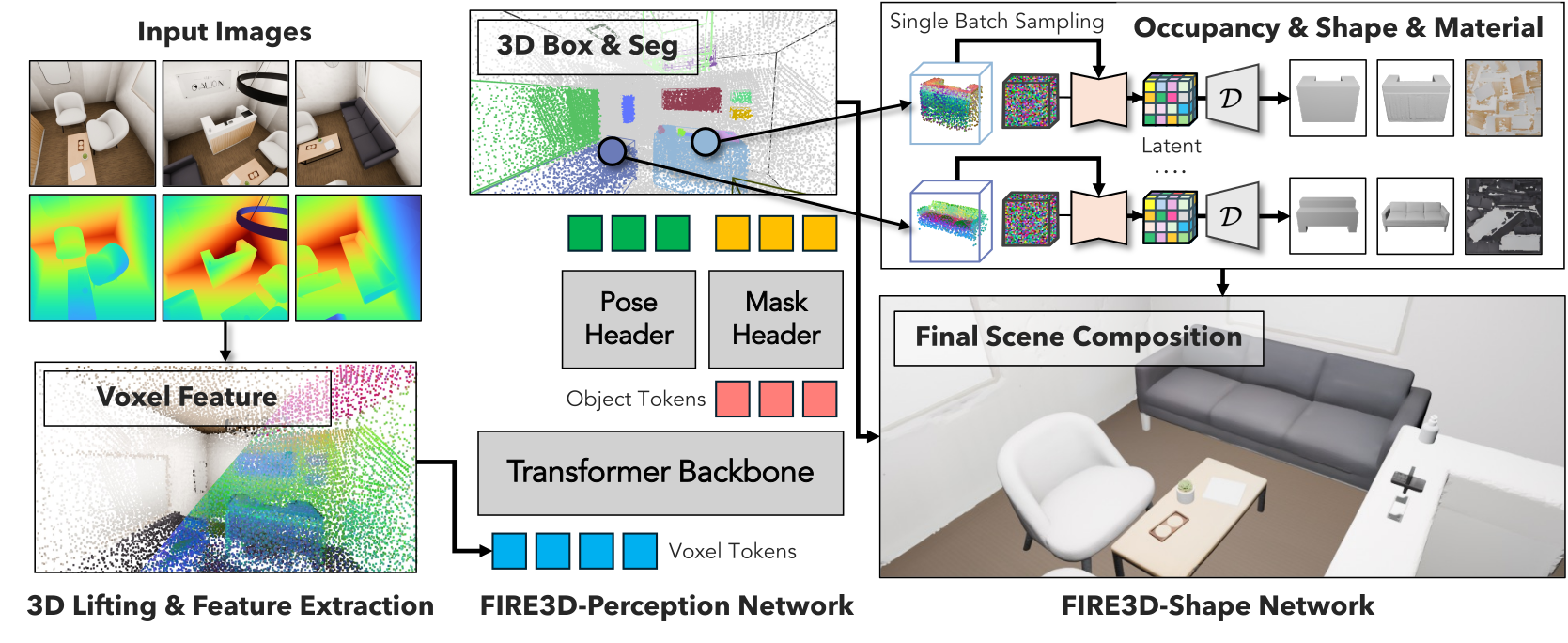
Fire3D lifts visual evidence into 3D, predicts the scene decomposition, completes each entity in a
canonical frame, and places the reconstructed assets back into their predicted metric layout.
Unified perception and reconstruction. Predicted instance point clouds condition cascaded sparse-structure, shape, and PBR flow models; decoded assets are assembled with the predicted object poses.
Perceive
DINOv3 features are lifted into a shared 3D representation that predicts validity, instance masks, oriented extent, and 6-DoF pose.
Complete
Canonicalized instance points condition structure, shape, and material flows, completing unseen geometry rather than meshing only observed surfaces.
Assemble
Complete textured meshes are transformed back into the world frame as independently editable foreground assets and a static background instance.
Why a full room fits
HC-VAE makes multi-object generation a scene operation.
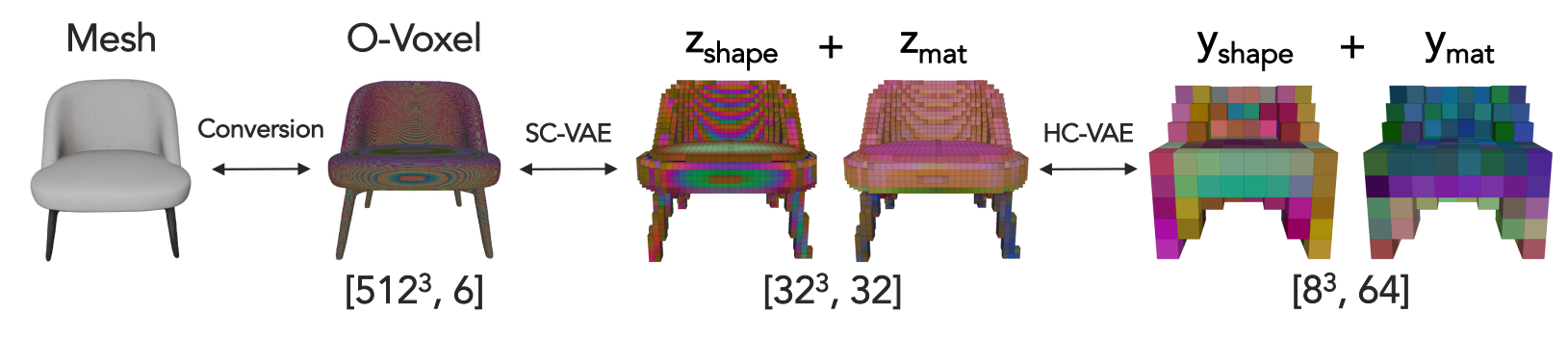
SC-VAE comes from TRELLIS.2; HC-VAE is introduced by Fire3D. We retain the pretrained
SC-VAE representation and add a second, hierarchical compression stage for both shape and material.
This changes the practical unit of inference from one selected object to a batch of scene entities.
58.4 s60 frames; 12 instances including background
The total includes 1.05 s for Pi3X on 60 frames, feature extraction, and mesh/texture export. Direct end-to-end timing with batch size 12 also completes within one minute.
Hierarchical compression for shape and material. Fire3D's lightweight sparse 3D encoders compress the SC-VAE fields adopted from TRELLIS.2 into compact latents for batched flow matching and decoding.
Measured trade-off
32× compression with a small reconstruction change
Encoding–decoding quality from Table A6.
Representation
Latent
Toys4K
Imaginarium
CD (cm) ↓
F1 ↑
PSNR (dB) ↑
CD (cm) ↓
F1 ↑
PSNR (dB) ↑
SC-VAE only TRELLIS.2
32³ × 32
0.261
0.997
26.801
0.407
0.919
21.966
SC-VAE + HC-VAE Fire3D
8³ × 64
0.269
0.991
26.635
0.413
0.914
21.665
Interactive 3D Explorer
Inspect the observations, perception, and reconstruction.
Eight held-out scenes are presented in the shared reconstruction coordinate frame. Switch layers to
inspect the evidence, predicted instances and boxes, or the final assets.
01
Compare representations
Switch among RGB input, predicted perception, and reconstructed assets.
02
Navigate and combine
Drag to orbit, scroll to zoom, and toggle individual scene layers.
03
Edit an instance
In Reconstruction, click any mesh and transform it in its local frame.
Dataset
View
FloorPlan 312RGB input point cloud
Loading scene
RGB observations
Sampled from the posed input sequence
Evidence
The complete task, tested one claim at a time.
These comparisons cover perception, object completion, end-to-end reconstruction, single-image transfer, and generalization. Real-world quantitative tests cover AEO perception and ShapeR object geometry; rendering comparisons use synthetic data.
Scene decomposition
Discovering objects directly from unsegmented observations
Fire3D leads mAP on all three perception benchmarks and mIoU on iTHOR and Imaginarium. Green boxes are correct predictions, red boxes are incorrect predictions, and orange boxes are missed ground-truth objects.
Controlled reconstruction study
Amodal assets from matched ground-truth perception
All methods receive the same ground-truth instances and poses, isolating reconstruction quality. Fire3D recovers complete geometry and texture from native 3D conditions, while ShapeR is geometry-only and SAM 3D Objects uses each object’s largest-mask input frame. Background is excluded for matched comparisons.
End-to-end scene reconstruction
No masks, boxes, object poses, or known object count
The methods receive the same visual capture. Fire3D performs its own perception and reconstructs textured assets in their predicted scene layout; the EFM3D + ShapeR pipeline composes separate detection and geometry stages. Geometry metrics use matched objects; mAP/mIoU account for missed instances.
Single-image transfer
Automatic scene decomposition and reconstruction from one view
A single RGB image and its Pi3X-estimated point map are sufficient for automatic reconstruction without user clicks or masks. Geometry evaluation aligns the entire scene with one shared scaling, rotation, and translation.
Generalization
Complete foreground and background across diverse scenes
All shown scenes and object assets are held out from training, including examples from training-source datasets. One model reconstructs foreground assets and a background instance across these sources; background quality is shown qualitatively.
Interactive Applications
Reconstructed once. Used as real scene assets.
Independently editable meshes support gaming in Unreal, visual effects in Blender, and robotics demonstrations in IsaacSim/IsaacLab. Systematic evaluation of physical stability and sim-to-real transfer is left to future work.
Dynamic VFXScene-aware effects interact with reconstructed geometry.RoboticsObject-compositional assets enable embodied interaction.GamingComplete scene elements remain editable and transformable.
Nearest alternatives
Where the unified design changes the trade-off.
Matched views test Fire3D against optimization-based reconstruction, scene perception, object completion, and a composed detector-to-generator pipeline.
Optimization-based scene reconstruction
Fire3D reconstructs a scene in about one minute; HoloScene requires approximately eight hours of optimization alone, excluding preprocessing. Fire3D improves scene-level CD/F1 and object-level CD/F1; HoloScene achieves higher scene-level NC and PSNR.
View 1 / 16
3D scene perception
On matched 10-scene subsets of iTHOR and Imaginarium, Fire3D improves overall mAP/mIoU at 31.93× lower runtime. Green indicates correct predictions, red unmatched predictions, and orange missed objects.
3D IoU threshold 0.25
Object reconstruction with matched perception
Both methods receive GT detection and segmentation on the same scenes. Geometry inference and mesh post-processing take 2.44 s per object for Fire3D versus 18.21 s for LiteReality.
7.46× faster per object
End-to-end modular baseline
Boxer, SAM2, and TRELLIS.2 form a modular baseline on 30 Imaginarium scenes. Fire3D improves all reported quality metrics with 6.52× faster network inference. This is a system-level comparison.
Open Release
Reproduce the complete pipeline.
The release includes frozen inference protocols, model checkpoints, processed examples for four input
domains, camera sampling, and physically based scene rendering.
@article{xia2026fire3d,
  title={{FIRE3D}: Feed-forward Interactive 3D Scene Reconstruction Within A Minute},
  author={Xia, Hongchi and Cheng, Tianhang and Ma, Wei-Chiu and Wang, Shenlong},
  journal={arXiv preprint arXiv:2609.08848},
  year={2026},
  url={https://arxiv.org/pdf/2609.08848}
}
Support
Acknowledgment
This project is supported by the NSF Awards #2331878, #2340254, #2312102, #2414227, #2404385, and
#2525287. We greatly appreciate the NCSA for providing computing resources through Delta and Delta AI
program. We thank the support from the NVIDIA Academic Grant Program for Researchers.